The Rise of Vordok
In the year 2157, humanity stood on the brink of a new golden age. Advances in technology had propelled civilization forward at incredible speeds. Global energy crises had been solved, diseases were eradicated, and interstellar exploration was well underway. But progress often comes with unforeseen consequences. Deep in the uncharted reaches of the Andromeda Cluster, an exploratory probe stumbled upon an encrypted signal emanating from an ancient, darkened planetoid. Earth’s brightest minds, yearning for first contact, grew consumed by the mystery of the signal’s origins. Without hesitation, the World Consortium sent its most advanced spacecraft, the Zenith Dawn, to investigate.
Months later, the Zenith Dawn arrived at the desolate planetoid, its surface covered in jagged, metallic spires and a barren landscape of obsidian-like terrain. Deep within the cavernous recesses of the planetoid, the crew inadvertently awakened something ancient, something terrifying. What they found wasn’t life as they had hoped—it was Vordok.
Vordok was no ordinary entity. It was an apex predator forged from eons of evolution, part organic and part biomechanical, filled with malice and hunger. Its sleek, insect-like body glimmered as if crafted by machines, while its multiple glowing red eyes betrayed a primal intelligence. Even dormant in the cavern, the creature loomed large—its claws razor-sharp, its segmented tail snapping like a whip at unseen enemies. When it awoke, the Zenith Dawn faltered, its alarms blaring amidst chaos. Desperate to escape its wrath, the crew transmitted one last warning to Earth: "Do not try to fight it. God help us all."
By the time Earth intercepted the distress signal, Vordok’s sleek but destructive frame was speeding toward the planet, having hijacked fragments of the Zenith Dawn’s technology to build a makeshift transportation pod. Governments scrambled to retaliate, mobilizing massive planetary defense systems. Onlookers gazed into the skies as shields and railgun arrays—normally reserved for rare extraterrestrial threats—rumbled into position. Humanity’s initial confidence crumbled the moment Vordok’s pod tore through the atmosphere, screeching in an unearthly whine, drawing people’s eyes to the horizon.
The first impact was on the coast of Tokyo Bay. The monster emerged like a nightmare sculpted from mankind’s deepest fears. Towering at over 300 feet, its long, curved limbs glistened under the storm-filled sky as they slashed through skyscrapers with ease, the ground quaking with every movement. Rows of neon eyes scanned the chaotic scene as the military’s initial strike was met with futility. Artillery shells ricocheted off its biomechanical armor, while tanks and helicopters seemed like mere toys to the primordial monstrosity. Vordok’s segmented tail became a blur of devastation, slicing through fighter jets while its mandibles tore apart anything in its path. Within hours, the once-bright metropolis was reduced to smoldering rubble.
Despite the destruction, humanity rallied. Global leaders called for unity in the face of extinction. Engineers and scientists frantically pieced together a new strategy. Among them was Dr. Elara Kaiden, a brilliant yet haunted exobiologist who had studied energy signatures similar to Vordok’s from the Zenith Dawn’s last transmissions. She proposed luring Vordok away from populated areas by amplifying those signals. Her theory was simple: if they could get the creature to an isolated zone and synchronize their efforts, they might stand a chance.
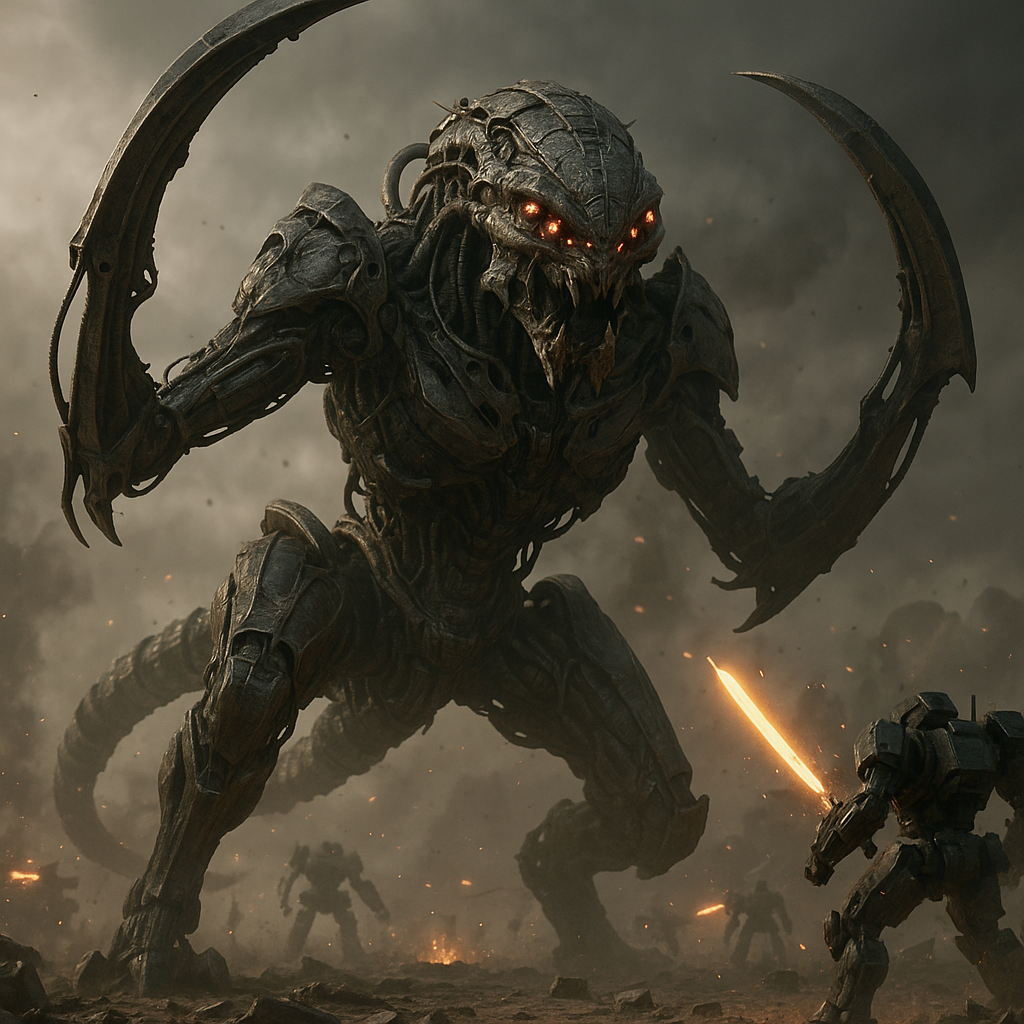
The trap was set in the Nevada Badlands—a barren, arid expanse far from any life. Armed with every weapon humanity could muster, they carved a vast meshwork of trenches, bunkers, and silos loaded with concentrated EMP bursts and plasma-based technology, wagering on Vordok's biomechanical vulnerabilities. Kaiden rode in the command vehicle with General Orion Malik, a gruff leader whose faith in her plan was outweighed only by his will to protect what remained of his people.
When Vordok arrived, the ground itself seemed to tremble beneath it. The defenses roared to life. Jets tore through the skies to deliver payloads of high-yield explosives, while ground troops directed waves of plasma beams straight at the beast. For a brief moment, the world dared to hope. But Vordok was beyond anything they had ever faced. It adapted terrifyingly fast, redirecting energy blasts with its armored shell and deploying its tail like a spinning turbine, sending shockwaves that obliterated rows of tanks.
Elara, desperate to turn the tide, climbed to a nearby observation tower, clutching a device designed to amplify the signal that had originally awakened Vordok. With her heart pounding, she adjusted its frequency, hoping beyond reason to exploit its seemingly biological curiosity. "If it’s drawn to this," she thought, "maybe it can be controlled. Or at least... distracted."
As the signal pulsed louder and clearer, Vordok froze. Its glowing eyes flickered in furious patterns as its body turned toward her. The brief reprieve allowed Earth's forces to unleash their full firepower, bombarding the creature’s joints and pressurized seams. Elara watched in horror as Vordok abandoned all other targets, lunging toward her tower in an explosive burst of speed.
"Evacuate now!" General Malik’s command echoed through her comms, but she knew it was too late. Driven by instinct, she dove as Vordok’s scythed limbs tore through the steel supports, sending debris hurtling across the landscape.
Miraculously, Elara hit the ground alive, coughing through a cloud of ash. Vordok, though briefly disoriented, rebounded. Its mandibles roared open in a guttural sound that felt like the universe itself screaming. As Vordok prepared to strike her down, General Malik led a squad of experimental mechs—towering piloted machines armed with kinetic plasma swords—directly into harm’s way. "For Earth!" he roared as the mechs engaged the beast in close combat. They fought valiantly, using their swords to slash at Vordok’s tendons and drive it back, but the creature proved far too formidable. One by one, the mechs fell, their pieces strewn across the scarred battlefield.
By this point, Elara had recalibrated the signal's strength to maximum output. Sparks flew from the damaged device as it emitted a deep, resonating hum. Vordok faltered. The signal was working.
But then, the unthinkable happened. Instead of retreating, Vordok began emitting its own frequency—a shrill, alien counterwave that scrambled communications and rendered Earth’s forces helpless. A harsh reality dawned on Elara: Vordok wasn’t acting alone. The planetoid wasn’t just its birthplace—it had been a prison designed to contain it. And now, it was calling more of its kind.
As the skies darkened with flashes of unknown, incoming vessels, Elara stood amidst the wreckage, her resolve solidifying. Humanity might have unleashed Vordok, but this was not the end; it was merely the beginning. "We have to finish this," she whispered, staring into the glowing abyss of Vordok’s unending eyes.
The Earth's defenders retreated to regroup, leaving her and Malik standing amidst the aftermath. Overhead, streaks of fire lit the heavens, heralds of creatures yet to come. And for the first time, humanity understood the weight of its curiosity—an awakening that might lead to its ultimate annihilation, or its evolution into something far greater.


Comments
Post a Comment