Shadows of the Hive
The sky over New York City darkened, not from a coming storm, but from an unnatural, foreboding eclipse. It was mid-August, 2026, and the summer heat clashed with an icy chill that crept through the streets. The citizens had no idea what was about to unfold. Near Central Park, a sudden tremor caused buildings to shudder, and birds scattered into the sky in chaotic flocks. The epicenter of the disruption wasn’t geological—it was something alive.
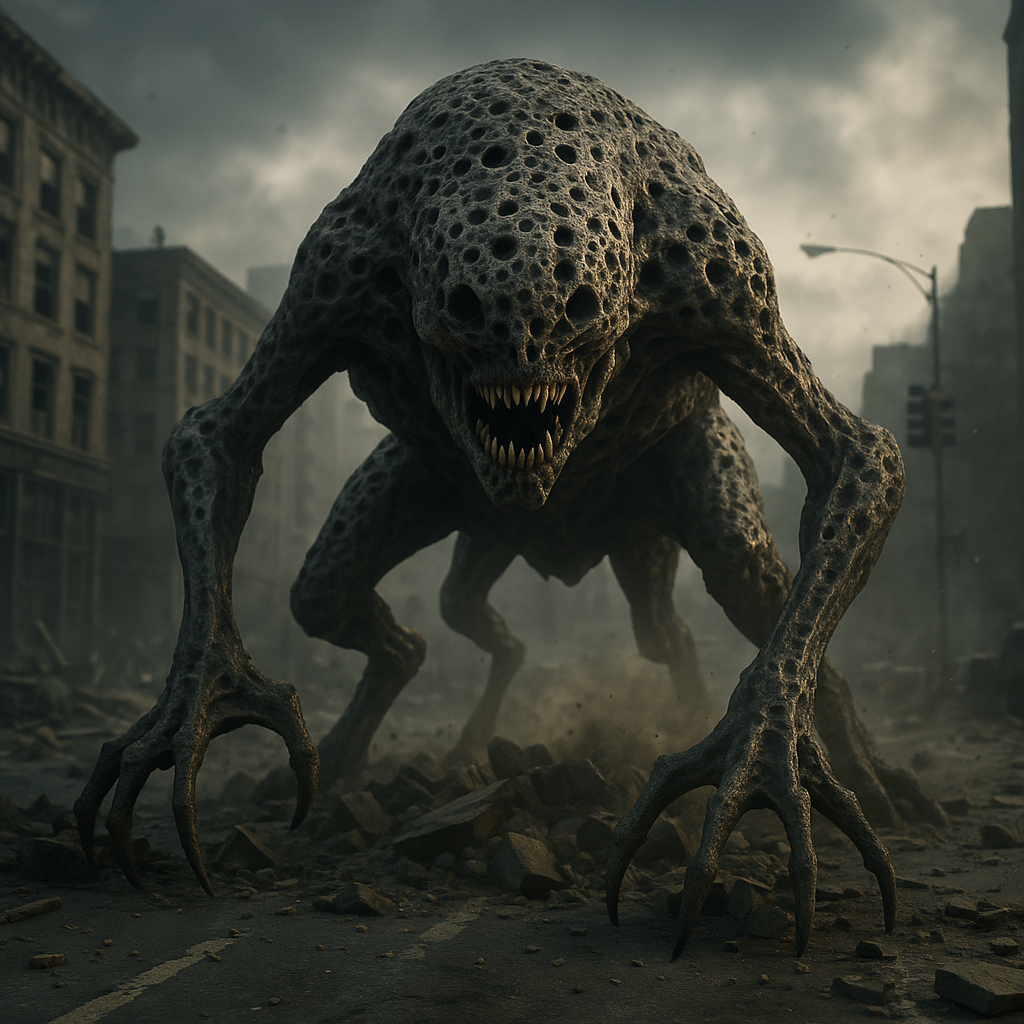
From beneath, it crawled. The first of the monstrous creatures emerged, clawing its way out through the shattered concrete of an abandoned subway tunnel. The creature’s horrifying form, a blend of insect and alien monstrosity, was five stories tall. Its bulbous head and porous exoskeleton glistened under the dim light seeping through the heavy cloud cover. Each of its spindly legs shattered streetlights and cars like paper as it moved with predatory grace. Terrified onlookers began fleeing in panic.
Claire Byrne, a photojournalist for The Post, was stationed on a nearby rooftop when the creature surfaced. Her camera was already rolling, capturing the beast’s emergence. Powerless to move, her hands trembled as she spoke into her recorder. “August 15th, 2026. I fear we are witnessing the start of the end. It’s… it’s something not of this Earth.”
As the monstrous entity moved through the city, a deep, resonant clicking sound emanated from it, a biological sonar reverberating through the air. People in its vicinity began to collapse, clutching their ears, blood seeping from their noses. The creature’s biofrequency was attacking the human nervous system.
The military was mobilized within hours. At West Point Military Base, Colonel Ethan Voss scanned the tactical display monitors within the war room. Satellite images showed multiple breaches worldwide—Tokyo, Moscow, Rio de Janeiro—all cities under siege from similar beings. Voss slammed his fist against the table. “This isn’t just an attack. It’s an invasion.”
In the heart of the chaos, Claire became the reluctant witness to humanity’s desperate struggle. The first wave of fighter jets roared past overhead, their missiles locking onto the beast. Explosions lit up the evening sky, but as the smoke cleared, it became apparent the creature’s porous exoskeleton was absorbing the impacts. Even as its body continued to move, smaller creatures—resembling six-legged spiders with similarly porous textures—began spilling out of the holes along its form. These swarm-like drones scurried through the city, leaping onto military vehicles and tearing through soldiers with razor-like mandibles.
Down in the underground shelters, scientists scrambled for an understanding. Dr. Lena Harlow, a biologist specializing in viral pathogens, stared at the anatomical scans retrieved from a downed drone. “These creatures… their structure isn’t just biological. It’s biomechanical,” she whispered. “Their exoskeletons are designed to adapt to environmental conditions. They’re not just surviving—they’re evolving in real-time.”
Above ground, Colonel Voss initiated Phase Two. Giant terrestrial drones, mechanoid titans engineered over the last decade after first contact with extraterrestrial signals, were deployed. Named the Ægis Units, the mechs were humanity’s largest and most ambitious defense project, towering as tall as the invaders. Painted in gleaming silver and equipped with electromagnetic cannons, they were humanity’s best shot.
Claire watched as the first Ægis Unit, piloted by a renowned ex-Marine named Jackson Reed, marched into Times Square. The mech’s cannons unleashed supercharged plasma bursts, each strike creating shockwaves that caused nearby glass to shatter. The massive alien stumbled but retaliated, spewing a corrosive black mist from its pores. The mist enveloped the mech, eating through the metallic joints.
Inside the Ægis Unit, alarms blared, and Jackson fought against the failing controls. He activated the emergency flamethrowers, igniting the mist and sending tendrils of fire crawling up the creature’s body. The monster screeched—a sound that rattled every bone in the human body—and stumbled backward. But its minions were already climbing on the mech like ants.
Realizing the danger of prolonged close combat, Lena worked alongside the remaining scientists to develop a countermeasure to the alien biofrequency. An experimental oscillator was fitted onto the second Ægis Unit, piloted by rookie pilot Asha Patel. As her mech entered the fray, she activated the device. A high-powered sonic wave emitted, canceling out the monster’s frequency and rendering its smaller drones inactive. Millions of the spider-like parasites collapsed, twitching on the ground.
The tide seemed to turn momentarily, but the celebration was short-lived. From the clouds above, the source of the creatures arrived. A mother entity—ten times larger than the others—descended in a crackling storm of electromagnetic energy. Its eyes were glowing orbs of intelligence and malevolence. Realizing this entity was a hive mind controlling the others, the survivors understood that destroying it might be their only chance to avoid annihilation.
With time running out, Colonel Voss ordered all forces to focus on the mother entity. Jackson and Asha piloted their Ægis Units in tandem, their combined strength firing a barrage of lightning-charged plasma rounds directly at the behemoth. Yet, the mothership emitted a barrier—a visible distortion in the air that sent waves of energy rippling outward, dismantling fighter jets mid-air and toppling entire buildings.
Claire, trapped near the battlefield with nowhere to escape, found herself under a collapsed traffic bridge. As chaos raged above, she focused her lens on a different angle of survival: humanity’s resilience. Her live-stream reached millions of viewers worldwide, uniting a terrified human population with shared hope and terror.
Asha, inside her damaged mech, made a desperate decision. Activating the Ægis Unit’s self-destruct mechanism, she ran her mech directly at the mother entity’s base. The resulting explosion was cataclysmic, creating a massive shockwave that toppled nearby skyscrapers. The hive mind shrieked as its energy barrier destabilized, allowing Jackson’s mech to deliver the final strike—a direct plasma burst through what seemed to be its core.
As the mother entity burst into a cascade of molten alien residue, the remaining drones instantly deactivated. All around the globe, humanity began to gain the upper hand, fighting back against the mindless remnants of the alien invaders.
When the dust settled, New York was left in ruins, but humanity had survived—barely. Claire’s footage of the battle became the definitive record of the invasion, a reminder of the price of survival. The aftershocks of these events went beyond Earth as humanity stared at the stars, understanding that they were no longer alone—and that they had taken their first step in an intergalactic war that had only just begun.


Comments
Post a Comment